
How Intelligent is AI Really?
Seems like AI is suddenly everywhere. Call customer service for almost any business other than a small mom and pop store, and you will probably be greeted with an AI voice that states confidently that it can help you and understands complete sentences. Spoiler alert… it almost always doesn’t. And, of course, the one sentence that it never seems to understand is “Can I speak to a live person?” Microsoft Word now includes a “What would I like to write?” prompt when opening a new document. What I would like to do is write something where Word minds its own business and keeps it opinions to itself (although help with spelling is always appreciated). At the top of Google search results and news site comments sections, there is now an automatically generated AI summary whether you want it or not. I find younger (okay, much younger) colleagues when asked to summarize anything of any length (or as my teachers used to say, “Put it into your own words”), their casual response is to drop the copy into ChatGPT and, voila, summarizing done. No re-write (or, apparently, reading the source material) necessary. Spoiler alert… a rewrite (and reading) is almost always necessary.
Until recently, I have managed to avoid AI-generated graphics. That changed this past autumn. I work on the design for a large veterinary conference held each January. Each year, there is a new theme, and the graphics are tailored to it. Signs, posters, handouts, digital advertising, booklets. Everything. The 2025 theme revolved around art/heart (veterinary medicine is an art as well as a science, and practitioners have a lot of heart). We rely heavily on stock images of animals to add interest to our designs. With a lot of animal images available on stock photo sites, most years we have plenty of options available. But those images are photographs, not “artwork.” Readily available images that worked for the art/heart 2025 theme were few and far between.
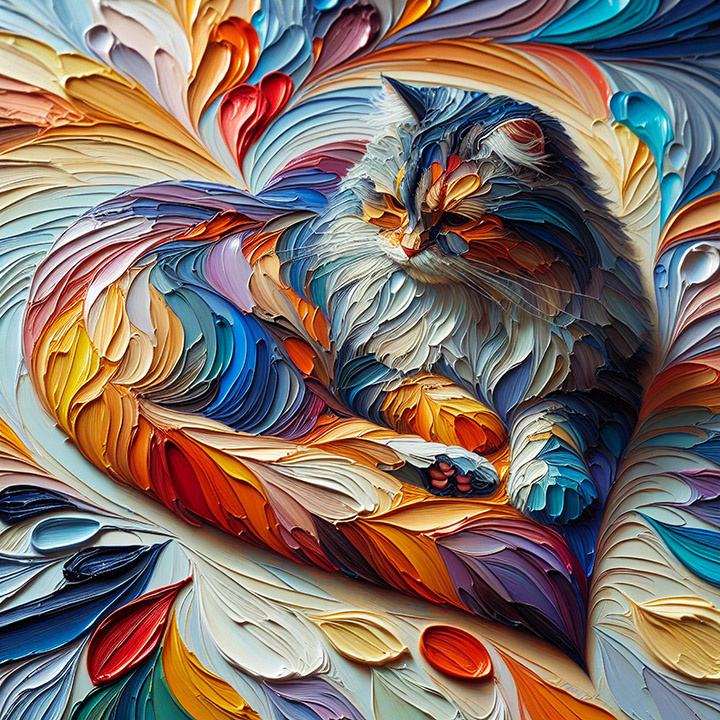
But AI came to the rescue. Turns out Shutterstock (our primary source of stock images) had just introduced an AI-generation function that my fellow designer and I quickly determined would be our new best friend for the next few months. Early on while just playing around I gave Shutterstock the prompt “Cat, Oil Painting, Heart, Brush Strokes” and it gave me back the lovely kitty at the top of this post. Wow. But that was a lot of beginner’s luck.
Other attempts were not so good and some were downright disturbing. Geckos with too many or not enough toes. Animals that were just plain mutants. Things of nightmares. Backgrounds with no consistent vanishing point or point of view. However, we quickly realized that we had stumbled upon a niche in AI-generated art. Images that looked like paintings had some built-in artistic license so there was some give and take. Animals were generally okay (even the aforementioned gecko worked nicely once I had evened out its toes). But people were just scary—too many fingers, eyes pointing the wrong way, two left feet, noses that just didn’t line up. And photo realistic images were generally a no go regardless of the subject. By the time the conference rolled around, we had created a plethora of custom AI-generated imagery, and the conference designs turned out amazing.
So, will AI replace graphic artists or illustrators anytime soon? Who knows? As a useful tool? Yes. As a complete replacement? Not any time soon. Or as I saw in a post not long ago on LinkedIn, “In order to replace creatives with AI, clients will need to accurately describe what they want. So, for now, we are safe.” Because often clients think they know what they want, but not what they need. And I don’t see AI bridging that divide anytime soon. Pretty kitty, or not.